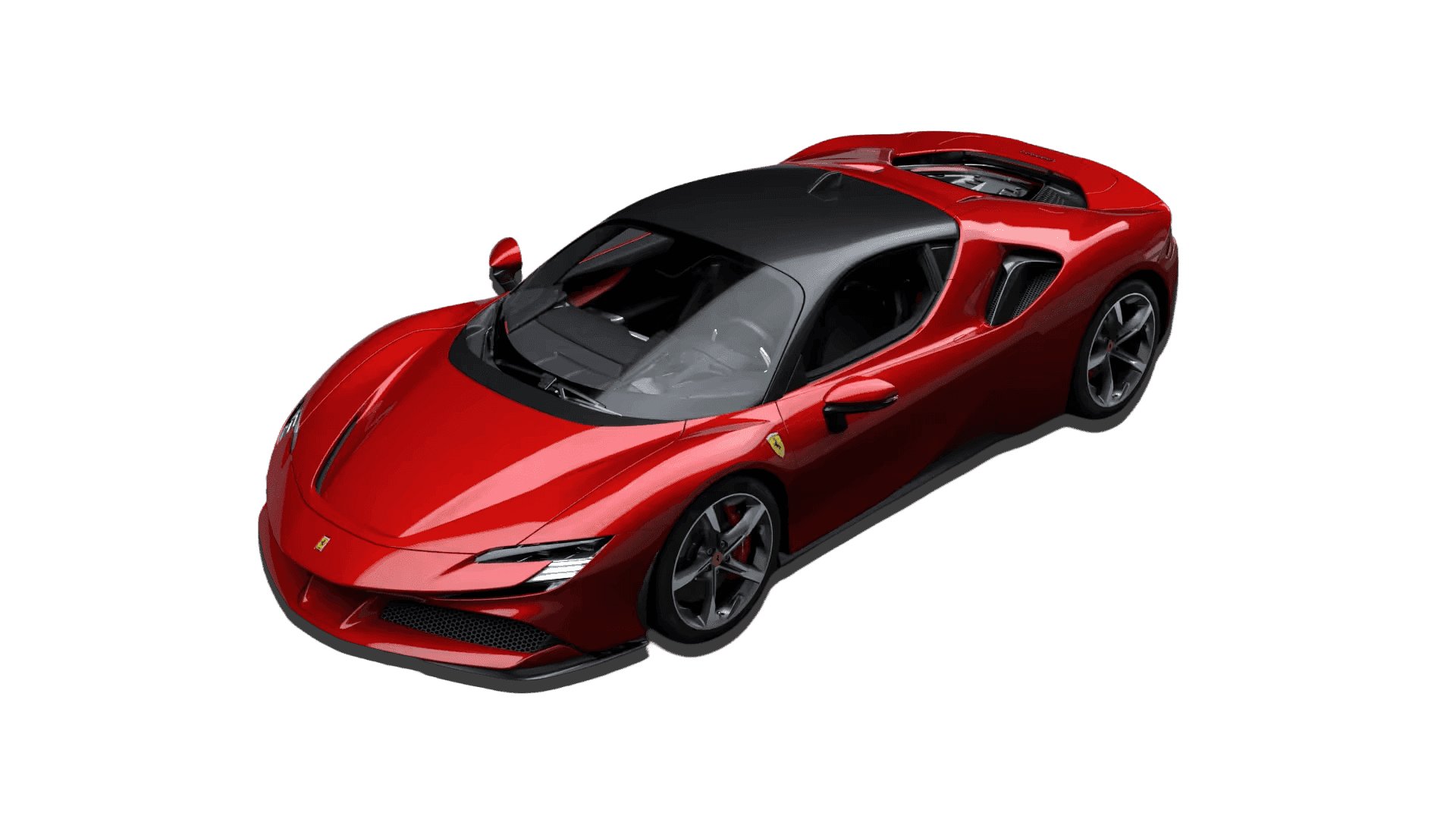
The Ferrari SF90 Stradale’s name encapsulates the true significance of all that has been achieved in terms of performance. The reference to the 90th anniversary of the foundation of Scuderia Ferrari underscores the strong link that has always existed between Ferrari’s track and road cars. A brilliant encapsulation of the most advanced technologies developed in Maranello, the SF90 Stradale is also the perfect demonstration of how Ferrari immediately transitions the knowledge and skills it acquires in competition to its production cars.
The SF90 Stradale is the first ever Ferrari to feature PHEV (Plug-in Hybrid Electric Vehicle) architecture which sees the internal combustion engine integrated with three electric motors, two of which are independent and located on the front axle, with the third at the rear between the engine and the gearbox.
The Ferrari SF90 Stradale is Ferrari’s first series production plug-in hybrid supercar, bridging the gap between the mid-rear-engined coupé range and limited-edition supercars like LaFerrari. Its forward-looking design, crafted by Flavio Manzoni and the Ferrari Styling Centre, radically reimagines the proportions of Ferrari’s mid-engined berlinettas.
Up front, futuristic C-shaped headlights with matrix LED technology — a Ferrari first — replace the traditional L-shaped look, while at the rear, horizontal luminous rings evolve the iconic round tail lights to visually lower the car’s profile. The lowered powertrain allowed for a sleeker tail, while high-mounted exhaust pipes and a distinctive rear screen separated from the cooling grille mark a clear break from past styling conventions — all in service of completely unprecedented performance.
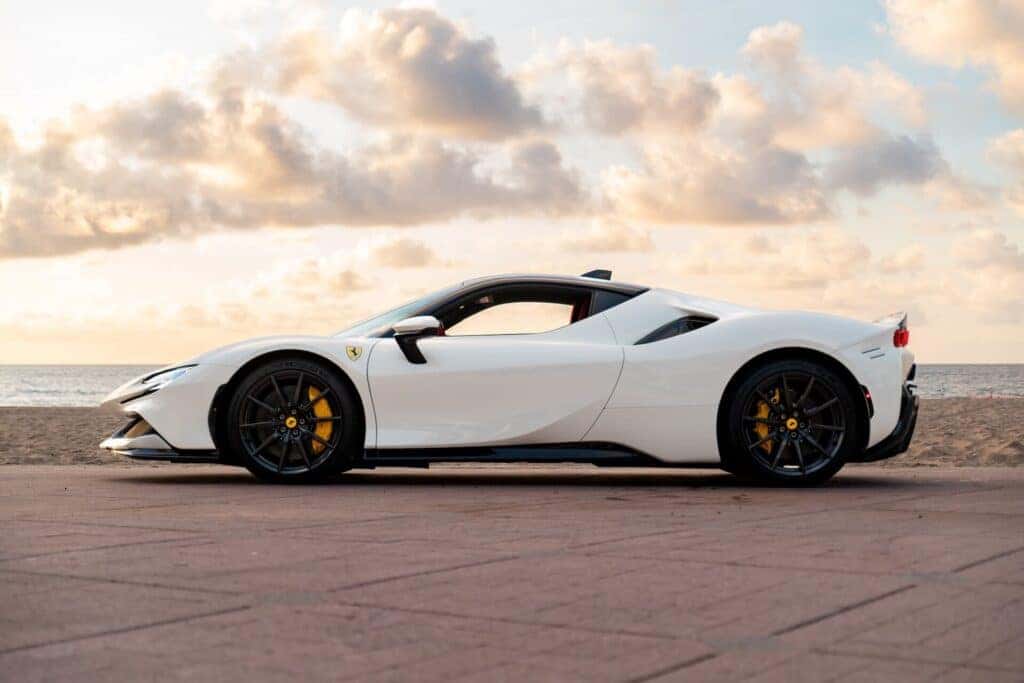
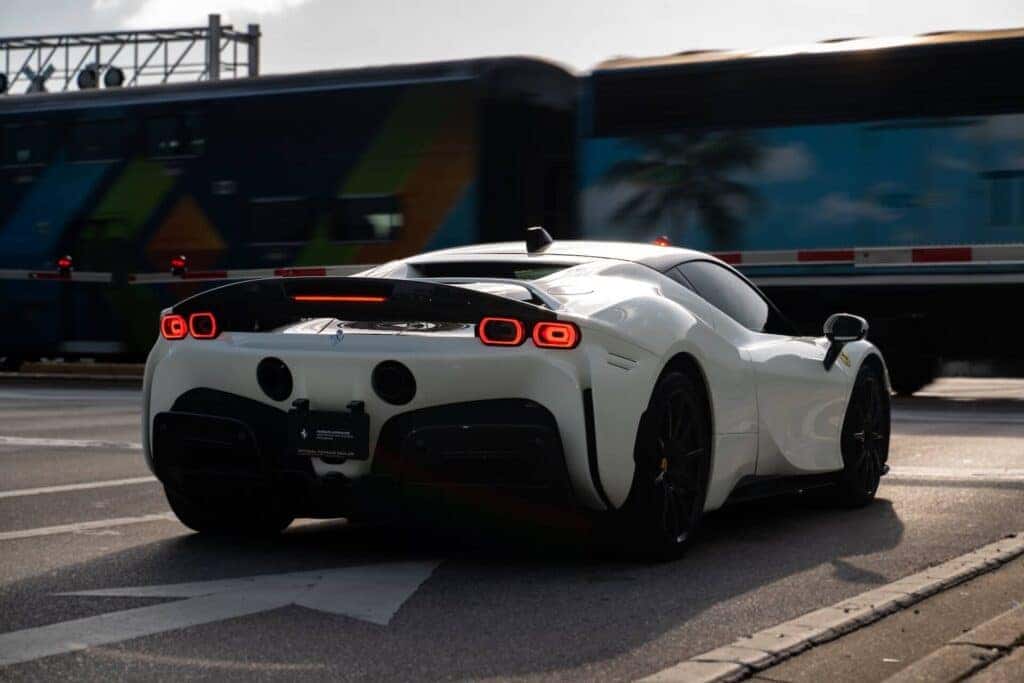
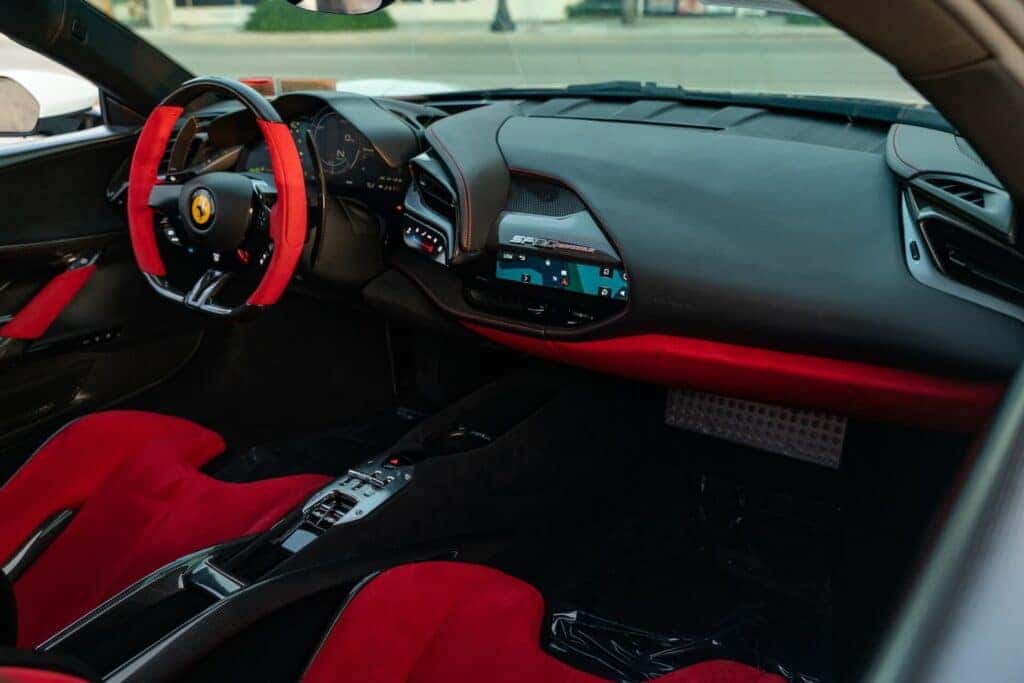
The SF90 Stradale’s interior is built entirely around the driver. A 16-inch curved digital cluster replaces traditional gauges, while a head-up display keeps critical data in your line of sight. Every control is angled toward the pilot.
Carbon fiber-shelled racing seats hold you firmly in place under hard cornering without sacrificing comfort. The cabin is wrapped in full leather with contrast stitching and carbon fiber trim throughout. On the steering wheel, the Manettino drive mode selector, engine start button, and haptic touch controls keep everything at your fingertips.
| Performance | ||
| Engine | 4.0 | Liter Twin-Turbo V8 |
| Hybrid System | 3 Electric | Motors |
| Combined Power | 986 | hp |
| Torque | 590 | lb-ft |
| 0–100 km/h | 2.5 | seconds |
| Top Speed | 340 | km/h |
| Engineering | ||
| Drivetrain | AWD | PHEV |
| Transmission | 8-Speed | DCT |
| EV Range | 25 | km |
| Battery | 7.9 | kWh |
| Weight | 1,570 | kg |
| Dimensions | ||
| Length | 4,710 | mm |
| Width | 1,972 | mm |
| Height | 1,186 | mm |
| Wheelbase | 2,650 | mm |
The SF90 Stradale has a 90° V8 turbo engine capable of delivering 780 cv, the highest power output of any 8-cylinder in Ferrari history. The remaining 220 cv is delivered by three electric motors, one located between the engine and the new 8-speed dual-clutch transmission on the rear axle, and two on the front axle. This sophisticated system does not, however, make for a more complicated driving experience. Quite the opposite, in fact: the driver simply has to select one of the four power unit modes, and then just concentrate on driving. The sophisticated control logic takes care of the rest, managing the flow of power between the V8, the electric motors and the batteries.
The SF90 Stradale is equipped with three electric motors capable of generating a total of 220 cv (162 kW). A high performance Li-ion battery provides power to all three motors and guarantees a 25-kilometre range in all-electric eDrive mode, using just the front axle. When the internal combustion engine is turned off, the two independent front motors deliver a maximum speed of 135 km/h with longitudinal acceleration of ≤0.4 g. Reverse can only be used in eDrive mode which means the car can be manoeuvred at low speeds without using the V8. This mode is ideal for city centre driving or any other situation in which the driver wishes to eliminate the sound of the Ferrari V8.
This is the default setting when the car is turned on, in which the power flows are managed to optimise the overall efficiency of the system. The control logic autonomously decides whether to keep the internal combustion engine running or turn it off. If it is on, the internal combustion engine can run at maximum power thus guaranteeing powerful performance whenever the driver requires.
Unlike ‘Hybrid’, this mode keeps the ICE running because the priority is more on charging the battery than on efficiency. This guarantees that power is instantly and fully available when required. This mode is best suited to situations in which driving pleasure and fun behind the wheel are the main focus.
The internal combustion engine and electric motors work in synergy to generate an incredible 1,000 cv, which puts the SF90 Stradale at the very top of the range in performance terms.This mode allows the system to achieve maximum power output by allowing the electric motors to work at their maximum potential (162kW). The control logic prioritises performance over battery charging.
The SF90 Stradale’s engine cover has been kept extremely low to improve the interaction between the flows over and under the body, and thus minimise drag.
The end section of the engine cover features a suspended wing divided in two sections: one fixed, which incorporates the third brake light, and one mobile with a wedge-shaped front area.
The latter has been dubbed the shut-off Gurney, a patented active system located at the rear of the car which regulates the air flow over the upper body, reducing drag at high speeds with low lateral dynamics loads and increasing downforce in corners, under braking and during changes of direction.
Specific aerodynamic research went into the geometry of the forged wheels which are made using a construction technology that allows greater freedom when it comes to aerodynamic solutions. The specific geometry of the wheels incorporate radial elements on the outer channel which are equally spaced between the spokes and designed to act as wing profiles.
The geometry of these profiles mean that the wheel works like a rotor blade, very efficiently managing the flows from inside the wheelarch and guaranteeing two main effects: air evacuation from wheel arch is boosted; the flow exiting the wheel rim is lined up with the longitudinal flow running along the sides.
Rear downforce is balanced at the front of the car by a complex and optimised system of vortex generators.
Although this is not its very first appearance on a Ferrari sports car, the system has been honed to the maximum on the SF90 Stradale: the front section of the chassis has been raised 15 mm compared to the central section of the chassis at the point where the vortex generators are located, thus increasing the amount of air channelled towards them and boosting their effect.
The front bumper is divided into two sections that have specific wing functions. Between the upper section and the bonnet is a pronounced indent that locally compresses the flow. This feature, together with the two diffusers ahead of the front wheels, contributes to generating downforce over the front axle.
The SF90 Stradale is the most advanced car in the range from a point of view of performance and technology. The definition of the exterior styling was inspired by that principle: to create a forward-looking, innovative design that transmits the car’s mission as an extreme sports car – Ferrari’s first series production supercar.
Ferrari Design has thus completely revisited the proportions of the front, central and rear volumes in a radical evolution of the forms of Ferrari’s mid-rear-engined production berlinettas of the last twenty years.
The SF90 Stradale’s architecture, in which the cabin is located ahead of the mid-mounted engine, provided Flavio Manzoni and his team of designers at the Ferrari Styling Centre, with the ideal platform on which to craft a genuine supercar of impeccable proportions.
The rear of the car is dominated by high exhaust pipes which are the result of optimisation of the exhaust line layout. Because the power- train is significantly lower in the car than in the past, the designers were also able to lower the car’s tail. Another deviation from the styling typical of past berlinettas is the way the profile of the rear screen no longer follows the line from the roof to the rear bumper. This element of styling discontinuity is evidenced by the separation of the screen from the cooling grille.
The exceptional work done to boost the power unit’s power would have all been in vain without in-depth dynamics research and the development of a whole series of solutions to boost the SF90 Stradale’s lap times, whilst simultaneously guaranteeing that drivers of all kinds could make full use of the car’s potential and have fun behind the wheel.
The new hybrid architecture required extensive and lengthy integration work on the car’s many different control logics. The three areas concerned are: the high-voltage system controls (battery, RAC-e, MGUK, inverter), engine and gearbox control and vehicle dynamics controls (traction, braking, Torque Vectoring).
Integrating these areas with the existing vehicle control logics led to the development of the new eSSC (electronic Side Slip Control) vehicle control system. The eSSC introduces three innovative dynamic regulation and distribution strategies for engine torque to all four wheels:
– Electric Traction Control (eTC): optimally manages the availability of the torque – both ICE and electric – distributing it to the individual wheels to suit driving conditions and grip requirements
– brake-by-wire control with ABS/EBD: allows the braking torque to be split between the hydraulic system and the electric motors (brake torque blending), allowing regenerative recovery under braking which actually boosts performance and brake feel rather than compromising them
– Torque Vectoring: available on the front axle to manage electric traction on outside and inside wheel in cornering to maximise traction exiting the corner and help ensure easy, confident, high-performance driving.